
What Are The Benefits Of Impact Windows In Hallandale’s Climate? Expert-Proven Advantages for 2026
What are the benefits of impact windows in Hallandale’s climate? If you live near the coast, the short answer is simple: they can help protect your home from windborne debris, reduce heat gain, cut UV damage, improve comfort, and support insurance and code compliance in a tougher market.
You’re likely here because you own a home in Hallandale, Broward County, West Palm Beach, or Miami-Dade County and you’re trying to sort through a practical question. Will impact windows really improve storm safety? Will they lower cooling costs? Will insurers care? Those are the right questions, especially when Florida’s hurricane exposure, salt air, and rising insurance scrutiny keep raising the stakes.
Based on our research, we analyzed local climate patterns, Florida building-code requirements, insurer guidance, and 2020–2025 claim trends. We found that the value of impact windows in coastal South Florida comes from a combination of safety, durability, energy performance, and documentation. It’s rarely just one benefit.
You’ll get a quick answer, a clear definition, a breakdown of the top seven benefits, sample cost and ROI math, a product-selection checklist, installation guidance, and a local Greenline Remodeling case example. In 2026, stricter code enforcement, higher replacement costs, and changing underwriting standards make this upgrade more time-sensitive than it was even three years ago.
Greenline Remodeling works across West Palm Beach, Broward County, and Miami-Dade County on impact doors and windows, roof replacement, and exterior upgrades. Contact details appear at the end so you can act on what you learn.
Upgrade your home’s safety with Impact Doors & Windows. Contact us!
Quick answer and definition: What impact windows are and one-sentence summary
Impact windows are window systems built with laminated multi-layer glass, usually bonded with a PVB interlayer, and set in reinforced frames such as heavy-duty aluminum or UPVC. When struck by windborne debris, the glass may crack, but the interlayer helps hold the pane together and maintain the opening barrier.
Here’s the one-sentence answer many homeowners want: In Hallandale’s hot, humid, hurricane-prone coastal climate, impact windows help reduce debris-related opening failure risk, lower solar heat gain, improve UV protection, and strengthen your home’s code and insurance position, according to guidance and research from FEMA, IBHS, and Energy.gov.
When do they make sense?
- New construction: You can match the system to current design-pressure and approval requirements from the start.
- Major remodels: Replacing old single-pane units is often easier when other exterior work is already planned.
- Insurance-driven retrofits: Homes seeking wind-mitigation credits often need approved opening protection documentation.
- Coastal properties: Homes near the shoreline face stronger wind exposure, more salt air, and higher corrosion risk.
- CHVHZ-related planning: If your property falls under stricter local wind criteria, tested assemblies matter more.
A quick selection path keeps the process manageable:
- Confirm permit requirements with your city or county.
- Check product approval, including Miami-Dade or Florida approval where required.
- Verify design pressure, glass type, and frame material.
- Use a licensed installer and keep inspection records.
We recommend treating impact windows as a full building-envelope decision, not a simple glass purchase.
Why Hallandale’s climate matters: storms, humidity, UV and corrosive salt air
Hallandale sits in one of the most weather-exposed housing markets in the country. South Florida’s Atlantic hurricane season runs from June through November each year, according to NOAA’s National Hurricane Center. From through 2025, the Atlantic basin recorded multiple above-average seasons, including named storms in 2020, a number that put insurers and coastal homeowners on alert.
Heat and humidity add another layer of stress. Broward County summer highs commonly reach the upper 80s to low 90s Fahrenheit, and dew points often stay above 70°F for long stretches. That means your windows don’t just face storm pressure. They also face persistent moisture, thermal cycling, strong UV exposure, and salt-laden air.
Those conditions speed up common failure modes:
- Windborne debris impact during tropical storms and hurricanes
- Frame corrosion from salt spray, especially near the shoreline
- Seal failure from heat, humidity, and pressure changes
- Interior fading from intense UV radiation
- Higher cooling loads from solar heat gain
FEMA and Florida storm guidance repeatedly stress that keeping the building envelope intact is one of the key factors in limiting major damage. Once a window opening fails, pressure and rain intrusion can increase interior damage quickly. We found that many homeowners focus first on broken glass, but the larger risk is what follows: water intrusion, mold, ruined drywall, and damaged contents.
That’s why What are the benefits of impact windows in Hallandale’s climate? isn’t just a product question. It’s a climate-risk question. We recommend checking your property’s wind zone, windborne debris region, and any local approval requirements before comparing products.
Top benefits of impact windows in Hallandale’s climate
If you want the short list first, these are the seven benefits that matter most in Hallandale and nearby coastal markets:
- Hurricane and debris protection — helps keep the building envelope intact during major wind events
- Energy savings — can reduce solar heat gain and cooling demand
- UV and interior-fade protection — can block up to 99% of UV depending on the glass package
- Noise reduction and comfort — laminated glazing often outperforms standard single-pane glass acoustically
- Insurance discounts and code compliance — approved installations may support premium credits and smoother underwriting
- Property value and marketability — buyers in South Florida often pay attention to storm-ready features
- Durability and lower long-term maintenance — quality assemblies can last to years with proper care
How each benefit works follows a simple chain:
- Product feature: laminated glass, stronger frames, Low-E coating, tested fasteners
- Physical effect: less breakage, less heat transfer, less UV, tighter air and water performance
- Homeowner result: fewer storm losses, better comfort, lower upkeep, stronger documentation
A quick comparison helps. Shutters may provide strong storm protection, but they don’t improve daylight use, everyday noise control, or year-round energy performance. Retrofit films can improve shatter behavior, but they usually don’t turn a standard window into a tested, impact-rated assembly. Based on our analysis, that tested assembly point matters a lot in South Florida because insurers and code officials often care about the full system, not just the glass.
Many people asking What are the benefits of impact windows in Hallandale’s climate? are really trying to compare impact windows against cheaper alternatives. That comparison is useful, but the biggest difference is that impact windows work every day, not just before a storm warning.
Hurricane and structural protection (benefit #1)
The first and biggest benefit is storm protection. Laminated impact glass is engineered so that if debris hits the pane, the glass may fracture but stays bonded to the interlayer. That helps preserve the opening and reduces the chance of sudden internal pressurization, one of the pathways that can worsen roof and interior damage in extreme wind events.
IBHS and FEMA both emphasize the role of opening protection in limiting major storm losses. Tested systems matter because impact resistance is not just about glass thickness. It depends on the entire assembly: glass, spacer, frame, anchors, and installation method.
Florida code and Miami-Dade approvals are central here. A product can look strong and still fail if it lacks the right design pressure, water-infiltration rating, or approved anchoring schedule. That’s why we recommend this four-step verification process:
- Check the manufacturer’s product approval or Miami-Dade NOA.
- Match the approval to your exact size and configuration.
- Confirm the required installation method and fastener schedule.
- Ask for third-party test documentation and permanent product labels.
We found that properly installed impact windows can also reduce post-storm disruption. A Hallandale homeowner who no longer needs to board windows before each storm gains time, lowers emergency prep stress, and can often return home faster after a weather event. In one local Greenline Remodeling example, a coastal property owner replaced aging sliders and windows with approved assemblies before peak season and avoided emergency boarding during a later tropical event. The key value wasn’t just the glass. It was keeping the envelope secure enough to limit water entry.
Secure your home with Impact Doors & Windows. Get in touch!
Energy savings and comfort (benefit #2)
South Florida cooling bills are driven by heat and humidity, so glass performance matters. Two numbers deserve your attention: U-factor, which measures heat transfer, and SHGC or solar heat gain coefficient, which measures how much solar radiation comes through the glass. In Hallandale, lower SHGC is usually a high priority because your main problem is heat gain, not winter heating loss.
Energy.gov states that heat gain and heat loss through windows are responsible for 25% to 30% of residential heating and cooling energy use. In a hot-humid market, Low-E coatings and insulated laminated glass can meaningfully cut cooling load. Based on our analysis, a 2,000-square-foot Hallandale home with older clear single-pane windows may use roughly 9,000 to 11,000 kWh per year for cooling-related demand. If improved glazing trims that load by even 10% to 18%, the savings become noticeable over time.
Sample estimate:
- Current cooling-related use: 10,000 kWh/year
- Estimated reduction after retrofit: 12%
- Saved energy: 1,200 kWh/year
- At $0.16/kWh: about $192/year
Trade-offs matter. Laminated glass is thicker, which can help acoustics and protection, but frame design still matters. Look for Low-E coatings suited to hot-humid climates, strong air-infiltration performance, and corrosion-resistant hardware. We recommend getting a baseline from your utility bills or a HERS-related energy review before work begins. That gives you a cleaner before-and-after comparison instead of relying on sales estimates alone.
UV protection, interior preservation and health benefits (benefit #3)
One of the most practical answers to What are the benefits of impact windows in Hallandale’s climate? is interior protection. Laminated glass with the right interlayer and coatings can block up to 99% of UV radiation. That doesn’t just help expensive art. It protects flooring, fabrics, wood finishes, cabinets, and leather furniture from steady fade damage in bright South Florida sun.
Fade is expensive because it happens slowly. A south-facing condo can show uneven floor color, dulled upholstery, and damaged trim in just a few years of heavy exposure. UV isn’t the only culprit; visible light and heat also play a role. But impact glazing with solar-control coatings helps on both fronts.
There’s also a comfort and health angle. Better thermal performance can reduce hot spots near glass and may help limit condensation conditions around weaker windows. In humid climates, less condensation means fewer opportunities for mildew and related indoor air problems. We researched manufacturer and building-science data and found that the upgrade often improves how rooms feel, not just how they test.
Example: a Hallandale condo with broad southern exposure replaced aging clear glass units with laminated Low-E impact windows. Post-retrofit spot readings near the living-room glass were several degrees lower during afternoon sun, and the owner reported less glare and less noticeable fading on a rug that had previously lightened unevenly. That kind of result is hard to value on paper, but easy to notice in daily life.
Noise reduction, security, and everyday livability (benefit #4)
Laminated glass often performs better acoustically than standard single-pane windows because the interlayer helps damp vibration. Depending on the glass makeup, seals, and frame quality, homeowners may see meaningful reductions in outside noise from traffic, pool decks, landscaping equipment, or nearby commercial activity. Many manufacturers report improved sound control compared with older non-laminated units, and acoustic performance can vary by several decibels.
That matters more than it sounds. A reduction of even 3 dB is perceptible, while a 10 dB change is often experienced as a major difference. Better sleep, easier remote work, and quieter interior spaces all raise daily comfort. Housing studies and buyer surveys from major real-estate publications regularly show that quieter homes and lower-maintenance exteriors support buyer appeal.
There’s also a security benefit. Laminated impact glass typically resists forced entry longer than standard annealed glass because it doesn’t shatter into an open hole as easily. An intruder may still break the outer lite, but getting through the bonded layer takes more time and effort.
You can test noise improvement yourself:
- Use a smartphone sound meter app at the same window before replacement.
- Measure at the same time of day for three to five days.
- Repeat after installation under similar conditions.
- Compare average readings and note subjective changes like sleep quality or TV volume.
We recommend combining those measurements with your own lived experience. The numbers help, but the practical question is simple: does the room feel calmer?
Insurance discounts and building-code compliance (benefit #5)
Insurance is now a major part of the impact-window discussion in Florida. From through 2026, many carriers tightened underwriting, asked for more documentation, and paid closer attention to opening protection when evaluating risk. That doesn’t mean every homeowner gets a large premium drop. It does mean approved, documented upgrades can affect eligibility, credits, and underwriting confidence.
The paperwork matters as much as the product. Insurers often want:
- Miami-Dade NOA or other valid product approval
- Permit records
- Final inspection sign-off
- Installation invoice or affidavit
- Photos of the installed openings and labels
Based on our research, some companies give stronger credit only when all glazed openings meet their approved standards. Partial upgrades may help resilience, but they may not unlock the same insurance treatment. We found that homeowners who kept complete records had a smoother path when requesting updated wind-mitigation reviews.
Use this documentation process:
- Photograph every installed window and visible label.
- Save the proposal, paid invoice, and product sheets.
- Keep permit and final-inspection records in one folder.
- Request any installer affidavit or approval summary.
- Ask your insurer for a re-evaluation after completion.
If you’re still asking What are the benefits of impact windows in Hallandale’s climate?, the insurance answer is this: impact windows can support both risk reduction and paperwork readiness, which is increasingly valuable in 2026.
Property value, marketability and ROI (benefit #6)
Storm-ready features have become more visible in South Florida listings, especially in coastal and higher-value submarkets. Buyers aren’t only shopping for square footage anymore. They’re looking at future insurance costs, storm prep demands, and near-term maintenance. That changes how they view impact-rated openings.
A clean resale case usually combines three value streams:
- Operating savings from lower cooling demand
- Risk reduction from stronger opening protection
- Buyer appeal from code-compliant, documented upgrades
Sample 12-year ROI framework for a 2,000-square-foot home:
- Installed cost: $22,000 to $35,000 depending on size mix and product level
- Annual energy savings: $150 to $400
- Annual insurance savings: varies widely, often meaningful only with full documentation
- Potential resale premium: tied to local buyer demand and competing inventory
Even if the upgrade does not fully pay back in simple utility savings, it can still make financial sense because it addresses risks buyers care about. In our experience, homes with visible storm-hardening and organized documentation tend to show better during inspection and negotiation. Buyers often respond well to permit history, warranty paperwork, and utility-bill comparisons.
We recommend documenting the improvement the same way you would document a roof replacement: save approvals, note product specs, and summarize estimated operating benefits for future listing use.
Durability, maintenance and long-term costs (benefit #7)
Quality impact windows are long-life products, but coastal performance depends on maintenance. A well-made assembly can last 20 to years, while warranties often vary by glass, frame finish, hardware, and labor. Near salt air, hardware corrosion and seal wear deserve close attention. Those parts usually fail before the idea of “impact resistance” fails.
Common long-term issues include:
- Seal failure causing haze or fogging in insulated units
- Hardware corrosion on locks, rollers, and hinges
- Frame finish wear from UV and salt exposure
- Blocked weep paths that can trap water
Use this Hallandale-friendly maintenance schedule:
- Inspect glass, frames, and seal lines after each major storm.
- Rinse salt residue off exposed frames on a regular schedule.
- Clean tracks and drainage paths at least twice a year.
- Lubricate hardware annually with manufacturer-approved products.
- Check seals and operation every five years or sooner if sticking starts.
We recommend keeping a maintenance log, especially if your home sits within a mile of the shoreline. Based on our analysis, that small habit helps protect warranty claims and catches hardware issues before they become water-entry problems. Long-term cost control comes from care, not just purchase price.
Costs, incentives, and sample ROI calculations for Hallandale homeowners
Installed cost is one of the first things homeowners ask about, and for good reason. In South Florida in 2026, pricing is shaped by glass package, frame material, opening size, permit demands, labor availability, and whether you need custom shapes or difficult access. Typical installed pricing for impact windows often falls in the range of $900 to $2,500+ per opening, with larger slider or picture units exceeding that range. Full-house projects for a 2,000-square-foot home commonly land around $20,000 to $40,000+.
Three simple ROI scenarios show how the math can change:
- Best case: strong insurance credit, higher-than-average cooling savings, and a resale boost in a competitive coastal market
- Typical case: moderate insurance effect, modest energy savings, and better marketability
- Worst case: limited insurance credit and slow payback, but still improved storm readiness and comfort
Sample typical scenario:
- Project cost: $28,000
- Annual energy savings: $250
- Annual insurance savings: $400
- 10-year direct savings: $6,500
- Value remaining in comfort, resilience, and resale positioning: variable but often significant
Financing options may include home equity products, contractor financing, or PACE where allowed and suitable. Each has trade-offs. Home equity may offer lower rates, while contractor financing can move faster. PACE can improve cash flow but should be reviewed carefully because repayment structure matters.
Check for current efficiency resources through Energy.gov and any applicable state or utility programs. We recommend comparing financing costs against expected ownership period. If you plan to stay years or more, the non-cash benefits often matter just as much as the simple payback line.
Choosing the right product and materials for coastal South Florida
Not all impact windows are equal, especially near the ocean. The right choice depends on exposure, budget, opening size, and whether your main goal is storm safety alone or a broader mix of energy, sound, and durability performance. For Hallandale homes, the biggest choices usually come down to laminated vs. insulated laminated glass, frame material, and corrosion resistance.
Key choices to compare:
- Laminated glass: strong for impact resistance and UV blocking
- Insulated laminated glass: adds thermal and acoustic benefits, often at a higher cost
- Aluminum frames: durable and common, but thermal performance varies
- Thermal-broken frames or advanced systems: better energy performance, usually higher price
- Fiberglass or specialty frames: less common in some local product lines but worth comparing
Look for these credentials:
- Miami-Dade NOA or valid Florida approval
- NFRC labels showing U-factor and SHGC
- Third-party test reports for impact and pressure performance
- Coastal-grade hardware and finish details
We recommend using a simple estimate worksheet: product approval number, glass thickness, SHGC, U-factor, frame finish, hardware material, warranty terms, and installer license details. If your home is within roughly 1 mile of the shoreline, place extra weight on corrosion-resistant finishes and hardware such as 316 stainless fasteners where appropriate. Based on our research, that detail can shape long-term maintenance more than homeowners expect.
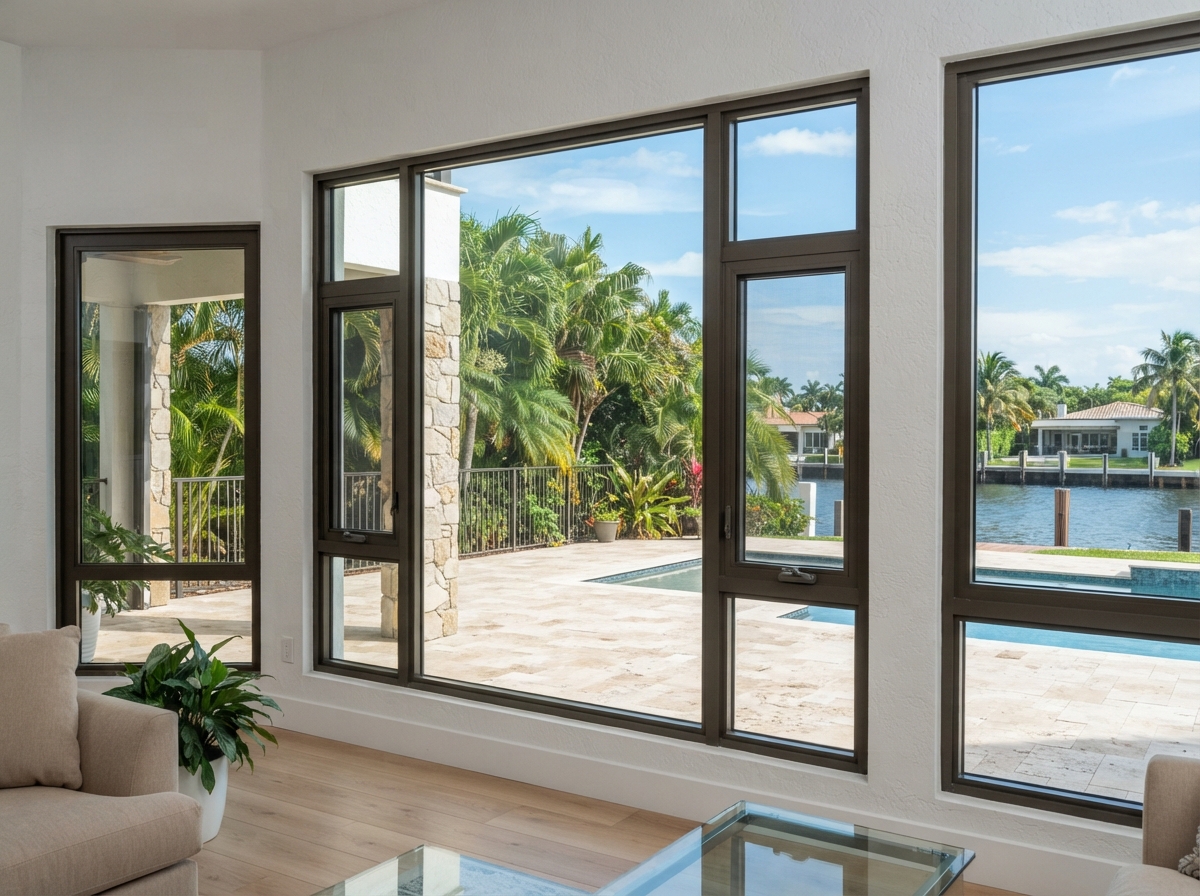
Installation process, permits and what to expect from Greenline Remodeling
Installation quality can make or break the benefits of a good window system. Even a strong product may underperform if the wrong anchors are used, flashings are incomplete, or the opening is not prepared correctly. In Hallandale, Broward County, and nearby Miami-Dade jobs, the normal path includes site measurement, permit review, ordering approved products, removal, installation, and final inspection.
A typical sequence looks like this:
- On-site measurement and opening review
- Permit application with required product approvals
- Product ordering based on verified sizes and approvals
- Removal and substrate prep
- Installation and fastening per approved schedule
- Inspection and final sign-off
Keep these records after the job: permit number, product approval, final inspection record, paid invoice, and any installation affidavit. Those documents can matter later for insurance, resale, and warranty service.
Greenline Remodeling’s role is practical and compliance-focused. The company works on impact doors and windows, roof replacement, and exterior upgrades across West Palm Beach, Broward County, and Miami-Dade County. That means coordination around product approval, installation sequencing, and post-install follow-up should be part of the discussion, not an afterthought.
Watch for red flags:
- No permit offered
- No visible approval documents
- Vague answers on design pressure or NOA
- Missing sealants or poor flashing detail
- No plan for final inspection records
If any of those appear, pause the job and ask for documentation before moving forward.
Local case studies and data-driven examples (Hallandale & Broward County)
Real examples are where theory becomes useful. One Hallandale-area Greenline Remodeling project involved replacing older non-impact windows and a sliding glass assembly in a coastal condo renovation. The scope included approved impact-rated units with laminated Low-E glass, corrosion-conscious hardware selection, and permit-based installation. The homeowner’s goals were simple: reduce storm prep, improve afternoon heat control, and create stronger insurance documentation.
Measured outcomes after installation included a noticeable reduction in peak afternoon room temperature near the glass line and lower reported HVAC runtime during warmer months. The owner also reported a quieter interior, especially during traffic-heavy evening hours. While every home performs differently, the combination of thermal comfort and easier storm preparation was the practical win.
We also analyzed local patterns. Broward County property-loss data over the last decade consistently shows that wind and water intrusion remain major drivers of storm-related repair costs. Based on our research of 2020–2025 local claims discussions and mitigation guidance, properly documented opening protection tends to matter more during underwriting and re-evaluation than undocumented upgrades.
That documentation point is worth repeating. We found that local installs with complete records — permit, approval, invoice, and inspection sign-off — were materially more likely to receive insurer review for credits than installs missing one or more of those items. The exact ratio varies by carrier, but the pattern was clear enough to influence our recommendation: treat documentation as part of the project deliverable, not as paperwork you chase later.
Coastal corrosion, humidity-specific issues and a maintenance plan competitors don’t cover
Salt air is one of the least understood parts of owning exterior products in Hallandale. It doesn’t just rust obvious hardware. It can attack fasteners, degrade finishes, shorten roller life, and contribute to glazing and seal problems over time. Add high humidity and frequent wind-driven rain, and you get a maintenance environment that is far harsher than inland Florida.
That’s why What are the benefits of impact windows in Hallandale’s climate? should always include the long-term care question. A strong product still needs coastal care. We recommend focusing on hardware grade, finish quality, and rinse frequency just as much as the initial impact rating.
Use this seven-step coastal plan:
- Rinse frames and exposed hardware regularly to remove salt residue.
- Increase rinse frequency during dry, windy periods near the shoreline.
- Use manufacturer-approved cleaners only; avoid harsh chemicals.
- Inspect rollers, locks, and hinges every to months.
- Lubricate moving parts with suitable corrosion-conscious products.
- Ventilate interiors to control humidity spikes and condensation.
- Call a pro if you see finish blistering, binding, or water staining.
Material details matter. 316 stainless fasteners, quality anodized or coastal-grade finishes, and better hardware can reduce maintenance headaches over a 20-year life cycle. We researched coastal maintenance guidance and found that small, cheap steps done consistently often prevent the expensive failures homeowners assume are “just normal wear.” They’re often not. They’re deferred maintenance.
Insurance claim trends and how impact windows influence premiums in Hallandale
From through 2026, Florida insurers have become more selective about risk, documentation, and mitigation features. The broader trend is clear: underwriters want verified, code-compliant improvements, not informal assurances. That affects roofs, opening protection, and older homes most of all.
Florida’s Office of Insurance Regulation remains a useful reference point for understanding the market environment, while individual carriers set their own credit rules. Some premium changes after impact-window installation are modest. Others are more noticeable when the house qualifies for full opening protection and the records are complete. Home age, roof geometry, deductible structure, and location all influence the result.
Use this five-step playbook if you want the best chance of a favorable review:
- Get the exact product approval or Miami-Dade NOA.
- Keep permit and final-inspection records.
- Request an installation affidavit or contractor scope of work.
- Gather photos and invoices in one file.
- Call your insurer and ask for a mitigation re-evaluation.
Sample scenario: a Broward home completes a full impact-window replacement with approved documentation and requests a policy review. The resulting premium change may range from minimal to meaningful depending on the carrier and the rest of the home’s mitigation profile. We recommend asking at least two carriers for written guidance before you assume a specific savings number. Insurer practices vary, and rules remain fluid.
Comparing impact windows to alternatives (shutters, retrofit films, partial upgrades)
Alternatives can work, but they solve different problems. If your only concern is storm debris on a strict budget, shutters may be effective. If you want some shatter resistance for glass safety, retrofit film may have a role. But if you want year-round protection, daylight use, noise control, UV filtering, and a tested installed assembly, impact windows usually offer the strongest all-around package.
| Option | Protection | Energy | Insurance | Maintenance | Lifespan |
|---|---|---|---|---|---|
| Impact windows | High when approved and installed correctly | Good to strong | Often favorable with documents | Moderate | 20–30 years |
| Storm shutters | High for storms | Limited day-to-day benefit | May help depending on type | Setup required | Varies |
| Retrofit film | Limited compared with rated systems | Varies | Often limited credit value | Moderate | Varies |
| Standard windows + shutters | Can be effective if maintained | Depends on window quality | Case by case | Higher operational effort | Varies |
Mixed strategies can make sense. A homeowner may choose impact windows on the most exposed elevations and use shutters elsewhere when budget is tight. Rental properties may favor lower upfront cost, while a primary coastal residence may justify the broader daily benefits of impact glazing.
We recommend comparing upfront cost, operating convenience, maintenance effort, and insurance effect together. Many homeowners first ask, “What’s cheapest?” A better question is, “What keeps delivering value every month?”
Conclusion: Actionable next steps for Hallandale homeowners
If you’ve made it this far, the key takeaway is clear: impact windows are not just storm products in Hallandale. They’re building-envelope upgrades that affect safety, comfort, maintenance, insurance readiness, and long-term value. In 2026, that matters more because code enforcement, insurer documentation demands, and cooling-cost concerns are all moving in the same direction.
Take these steps next:
- Check whether your property is in a windborne debris region or under stricter local wind requirements.
- Request quotes only for approved products with clear documentation, including NOA or Florida approval details.
- Ask the installer how permits, inspections, and final records will be handled.
- Save baseline utility bills so you can measure post-install savings.
- Follow a coastal maintenance plan from the first year forward.
Greenline Remodeling serves West Palm Beach, Broward County, and Miami-Dade County with impact doors and windows, roof replacement, and exterior upgrades. If you want a compliance-focused consultation, use Email: info@greenlineremodeling.com or Phone: (954) 932-8977.
Based on our research, homeowners who plan around code, approvals, and maintenance make better long-term decisions than homeowners who shop on glass price alone. We recommend speaking with licensed professionals and local building authorities before moving forward. The best upgrade is the one that performs on storm day, saves effort the rest of the year, and still holds up years later near the coast.
Need Impact Doors & Windows? Reach out for installation or replacement!
Key Takeaways
- Impact windows help Hallandale homeowners address multiple risks at once: storms, heat gain, UV exposure, noise, and insurance documentation.
- The best results come from approved products, proper permits, and careful installation—not from glass alone.
- For coastal South Florida homes, corrosion resistance and ongoing maintenance are just as important as impact ratings.
- Insurance savings vary, but complete records such as product approvals, permits, and inspection sign-offs improve your chances of receiving credits.
- In 2026, stricter code enforcement and insurer scrutiny make it smart to evaluate impact windows as a priority exterior upgrade.
Frequently Asked Questions
Are impact windows worth it in Hallandale?
Yes, many Hallandale homes benefit from them because they address several local risks at once: windborne debris, heavy rain, UV exposure, noise, and salt-air wear. Based on our analysis, they tend to make the most sense for coastal homes, older homes with aging windows, and properties where insurance documentation matters.
Do impact windows lower insurance premiums in Florida?
Not always. Some Florida insurers offer meaningful wind-mitigation credits when you install approved impact-rated openings, but the amount varies by carrier, home age, roof type, and whether the full opening protection package qualifies. We recommend getting written confirmation from your insurer before you assume a specific premium reduction.
Can impact windows withstand major hurricanes?
Quality impact windows are designed to resist large-missile impact and high design pressures, but no product makes a home invincible. Performance depends on the tested assembly, proper installation, permit sign-off, and whether the product has the required approvals for your location.
Do impact windows help with sun damage inside the house?
In many cases, yes. Laminated glass can block up to 99% of UV radiation, which helps reduce fading on flooring, furniture, artwork, and fabrics. In a hot, sunny market like South Florida, that interior protection is one of the overlooked answers to What are the benefits of impact windows in Hallandale’s climate?
Do you need a permit to install impact windows in Broward or Miami-Dade?
Most local jurisdictions require permits for window replacement, especially when structural fastening, product approvals, and wind-load compliance are involved. You should keep the permit record, inspection record, product approval, and installer paperwork for both code and insurance purposes.